Mini-Z Upgrades: The Complete Guide
Mini-Z upgrades ranked by impact: bearings first, then tires, T-plate, motor, and electronics. The full upgrade path for MR-03, MR-04, and MA-020 racers.
MR-03 · MR-04 · MA-020
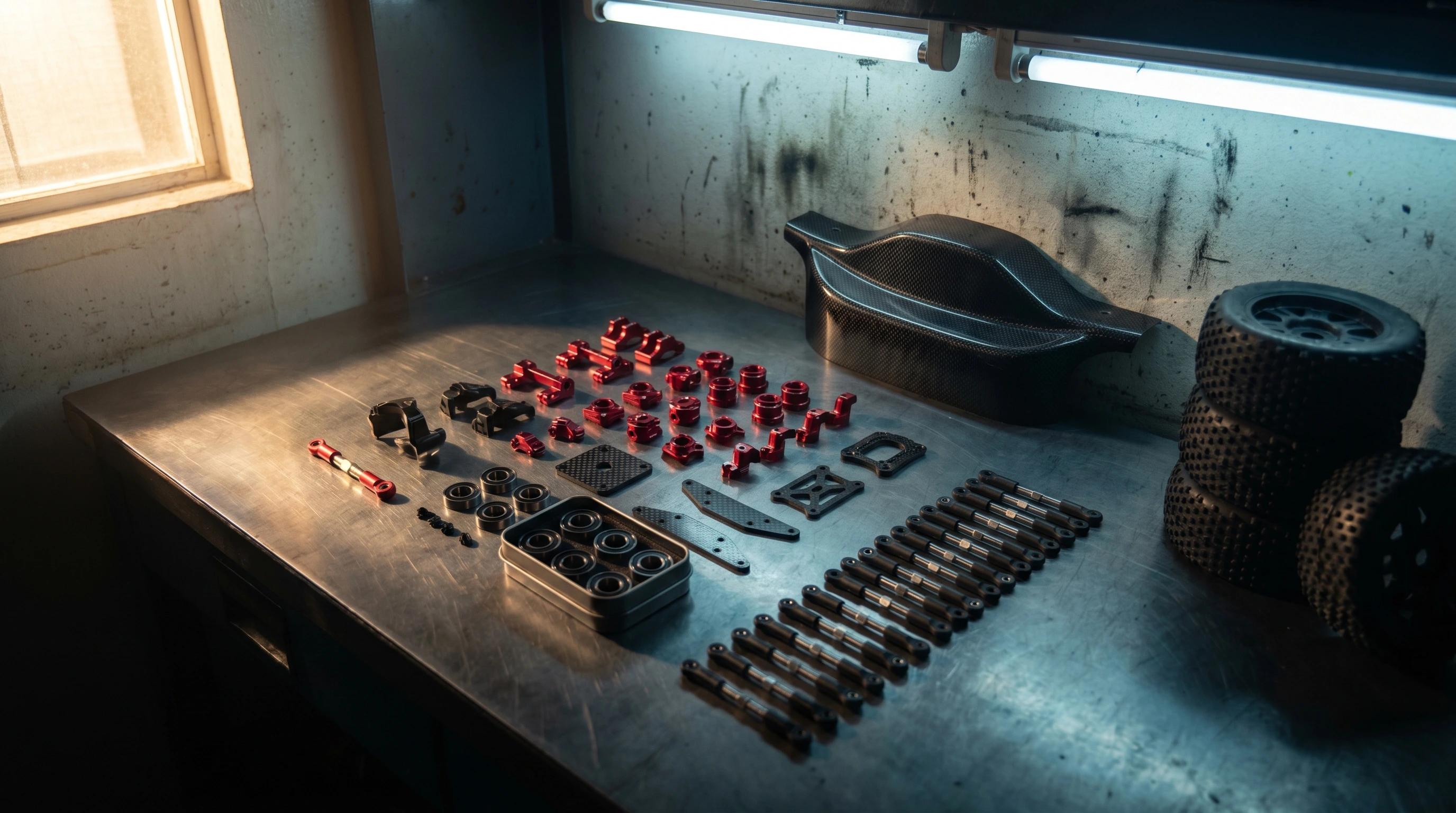
Every Mini-Z owner ends up asking the same question at some point: what do I upgrade, and in what order?
The good news is the sequence is well established. After a decade-plus of club racing on MR-03, MR-04, and MA-020 platforms, there is genuine consensus on what moves the needle and what doesn’t. The upgrade order below reflects that. Follow it and you’ll spend less, learn more, and drive faster than the person who jumped straight to a brushless motor and skipped bearings.
Why Upgrade Order Matters
Mini-Z upgrades interact. Bearings under a brushless motor matter more than bearings under a stock brushed motor. The right tire compound matters more on a car with a dialed T-plate than on a car with a sloppy chassis flex. Electronics tuning is almost useless without mechanical baseline first.
The sequence isn’t arbitrary. It’s the order that lets each upgrade actually express itself.
Tier 1: The Foundation (Do These First)
These four upgrades apply to every Mini-Z on every platform. They’re cheap, high-impact, and they unlock everything that comes after.
1. Ball Bearings
The most impactful upgrade on any Mini-Z, period. Stock ReadySets run plastic injection-molded bushings at the wheel hubs and drivetrain. They create friction, introduce slop, and wear fast.
A full bearing set replaces every bushing with precision steel bearings. The car rolls freer, spins up faster, and holds speed through corners. You’ll feel it on the first run.
Do this before anything else. The Bearing Upgrades guide covers the steel vs ceramic decision and which positions actually justify the premium. Browse the full lineup on the Shop Bearings page.
2. Tire Compound
Stock tires are a compromise. They ship with the car and they work well enough to get you lapping. But once you know what surface you’re racing on regularly, matching your compound transforms consistency.
RCP foam requires softer compound than carpet. Carpet needs something different than hardwood tile. Mismatched compound is one of the most common reasons a Mini-Z feels randomly inconsistent from session to session.
The Mini-Z Tire Guide is the starting point: surface baselines, symptom-based tuning, and what to buy first. For RCP-specific picks with exact part numbers, see the Best RCP Tires buyer’s guide. Once you’ve picked a compound, truing and gluing the tires is what actually makes that compound repeatable run to run. Browse the full compound and width lineup on the Shop Tires page.
3. T-Plate Upgrade
The T-plate is the primary rear suspension tuning lever on RWD Mini-Z platforms. It controls how much the chassis flexes under acceleration load and how the rear settles through corners.
The stock plastic T-plate has limited flex options. Upgrading to carbon fiber opens up a real tuning range. Stiffer plates work better on high-grip surfaces like RCP. Softer plates help on low-bite surfaces or bumpy club tracks.
Beginners often run medium flex and find the car immediately more predictable. Experienced racers tune T-plate and tire compound together as a system. The T-Plate Setup guide covers how to read the car and choose the right flex for your conditions. Browse T-plates, springs, and sway bars together on the Shop Suspension Parts page.
4. Pinion Gear / Gear Ratio
This one gets skipped because it’s cheap and not obvious. It shouldn’t be.
Changing the pinion tooth count changes your effective final drive ratio. More teeth means higher top speed and more motor load. Fewer teeth means more torque and acceleration at the exit of tight corners.
On most indoor tracks with short straights, dropping one or two teeth from stock gives you better drive off corners without touching the motor. It costs under $10 and takes five minutes. The Mini-Z Pinion Gear Ratio Reference covers exact ratios by tooth count across all platforms with surface and motor-type context. Browse the full motor and pinion lineup on the Shop Motors page. It’s also the tuning variable most club racers set once and never revisit, which is worth fixing since it costs nothing.
Tier 2: Electronics (After the Foundation is Solid)
5. Gyro
If you’re running an MR-03, MR-04, or any RWD Mini-Z and dealing with snap oversteer, a gyro is the fix. It feeds counter-steer faster than you can react, catching the rear before the slide starts. At 1/28 scale, RWD cars can be genuinely twitchy. A gyro makes the car actually drivable at competitive speed.
This isn’t a training-wheels upgrade. Fast club racers run them. The question is gain level and direction, not whether to use one.
For MA-020 AWD: skip the gyro. AWD architecture handles rear stability differently. Your electronics slot belongs to diff tuning and ESC settings.
The Gyro Setup guide covers installation, direction setting, and dialing in gain on the MR-03 and MR-04. Browse gyros, ESCs, and servos together on the Shop Electronics page.
6. FET Mod (Brushed Racers)
If you’re staying brushed, do the MOSFET swap before you tune anything else on the electronics side. The stock FETs on the Kyosho receiver board have relatively high internal resistance. Under load they get warm. Under a modified or low-turn motor, they get hot enough to limit performance and eventually fail.
Replacing them with low-resistance alternatives costs about $15 and 20 minutes of soldering. Lower resistance means less heat, better throttle response, and more consistent power delivery. For most brushed racers this is the electronics upgrade that makes the most difference at the least cost.
The FET Mod guide covers the MOSFET replacement and stacking process for MR-03 and MA-020 boards.
7. Servo Upgrade
The stock servo is adequate for casual use. Once you add a gyro and start chasing lap time, though, some drivers find the stock unit slow enough to cause hunting or a slightly lazy turn-in feel. A purpose-built aftermarket servo eliminates that ceiling.
Mini-Z uses a proprietary servo bay. You need a Mini-Z-specific unit, not a generic micro servo. Kyosho, Sanwa, and Atomic all make compatible options.
The Servo Upgrade guide covers when the stock servo is actually limiting you, what specs matter at 1/28 scale, and which units are worth the price.
Tier 3: Drivetrain and Motor
8. Differential Upgrade
The differential allows the inside and outside wheels to spin at different speeds through corners. Stock gear diffs are functional and low maintenance. Ball diffs are smoother and more tunable, but they require periodic rebuilding.
On RCP track, a well-set ball diff noticeably improves corner exit drive. On looser surfaces where consistency matters more than ultimate performance, a tight gear diff is often the better choice. The Ball Diff vs Gear Diff guide breaks down the decision by surface, driving style, and platform, and the shorter Stop Overthinking It take covers the same call in about a third of the words if you just want the answer.
9. Brushless Conversion
The brushless conversion is the performance ceiling raiser. More power, more efficient, longer lasting, and it opens up LiPo battery compatibility. It is also the most involved upgrade on this list.
You need a compatible ESC alongside the brushless motor. Stock receiver boards are not brushless compatible. For MR-03, the conversion path involves the motor, a third-party ESC, and a LiPo battery tray. For MA-020, the same principle applies.
The Brushless Conversion guide covers motor KV selection, ESC compatibility, LiPo wiring, and what actually changes on track.
For MA-020-specific motor upgrade sequencing (including FET work, class rules, and brushless setup), see the MA-020 Motor Upgrade guide.
Upgrade Path by Platform
MR-03
The MR-03 has the deepest aftermarket support of any Mini-Z platform. Parts availability, community knowledge, and setup guides are excellent. The standard upgrade sequence follows the tier order above.
See the MR-03 Platform Guide for the full competitive build path. Budget-conscious? The MR-03 First Upgrades Under $50 covers the first tier without burning money on diminishing-return parts.
MR-04
The MR-04 is the current flagship. Lower center of gravity out of the box, sensored brushless support, updated front-end geometry. Many of the same upgrade parts apply, but front-end components (springs, knuckles, bearings) are MR-04 specific and do not cross with MR-03.
See the MR-04 Platform Guide and the MR-04 Setup Guide for platform-specific tuning.
MA-020
The MA-020 AWD runs the same tier-one upgrades but the diff setup is more complex (front and rear), the motor upgrade path has class-rule implications, and gyro is generally not needed. AWD stability changes the electronics priority.
See the MA-020 Platform Guide for the full sequence and the MA-020 AWD Setup Guide for surface-specific dialing.
Upgrade Path by Budget
Under $50: Bearings, a pinion set, one set of matched tires. Transforms the car, costs almost nothing. Start here.
$50 to $120: Add a T-plate and a gyro. This is the “actually competitive at club night” zone for most racers.
$120 to $250: FET mod or brushless conversion depending on class. At this point you’re dialing individual components, not filling gaps.
Above $250: Ball diff, ceramic bearings in high-load positions, servo, transmitter upgrade. Real returns are narrow. The driver matters more than the parts at this level.
For the full diminishing-returns analysis on where upgrade spending stops paying off, see the Diminishing Returns Trap guide.
What the Fast Club Racers Actually Run
Beginner default: stock or minor upgrades, often too much too fast in the wrong order.
Intermediate club racer: bearings, matched tires, carbon T-plate, gyro, pinion set dialed for the local track.
Fast club racer: all of the above plus FET mod or brushless, ball diff, practiced maintenance routine. Not necessarily more parts, but the parts are better dialed.
The best-running cars at any club night are not always the most expensive ones. They’re the most thoughtfully set up ones. If you want to understand what “thoughtfully set up” means on paper before you go to your first club night, the How to Read a Setup Sheet guide explains every field you’ll encounter. Once you’re past this list, browse the performance guides for the deeper tuning content this overview only summarizes.
Prices are approximate and change often. Check the listing for current pricing.
Sealed bearings for the MR-03. What I run on mine. Drop-in replacement, sealed so they do not grit up.
Shop →OEM replacement bearings. Drop-in fit, no modification needed.
Shop →Ceramic balls, steel races. ABEC 7 rated. Lower friction than steel, no rust.
Shop →Full ceramic races and balls. Lowest rolling resistance available. Fits MR-02/MR-03/MR-015.
Shop →Drop-in sealed bearing kit for the MR-04EVO2 drivetrain. Model-specific sizing. Not interchangeable with MR-03 sets.
Shop →Budget full-steel bearing kit for the MR-03 drivetrain. The "if you just want to get started" pick over OEM plastics.
Shop →Hybrid ceramic bearing set sized for the MA-020 AWD drivetrain. Lower rolling resistance than steel, no rust on the front axle.
Shop →