How to True and Glue Mini-Z Tires for Consistent Grip
Truing and gluing Mini-Z tires the right way: why it matters, the exact process, diameter matching, and the tools that make it repeatable.
MR-03 · MR-04 · MA-020
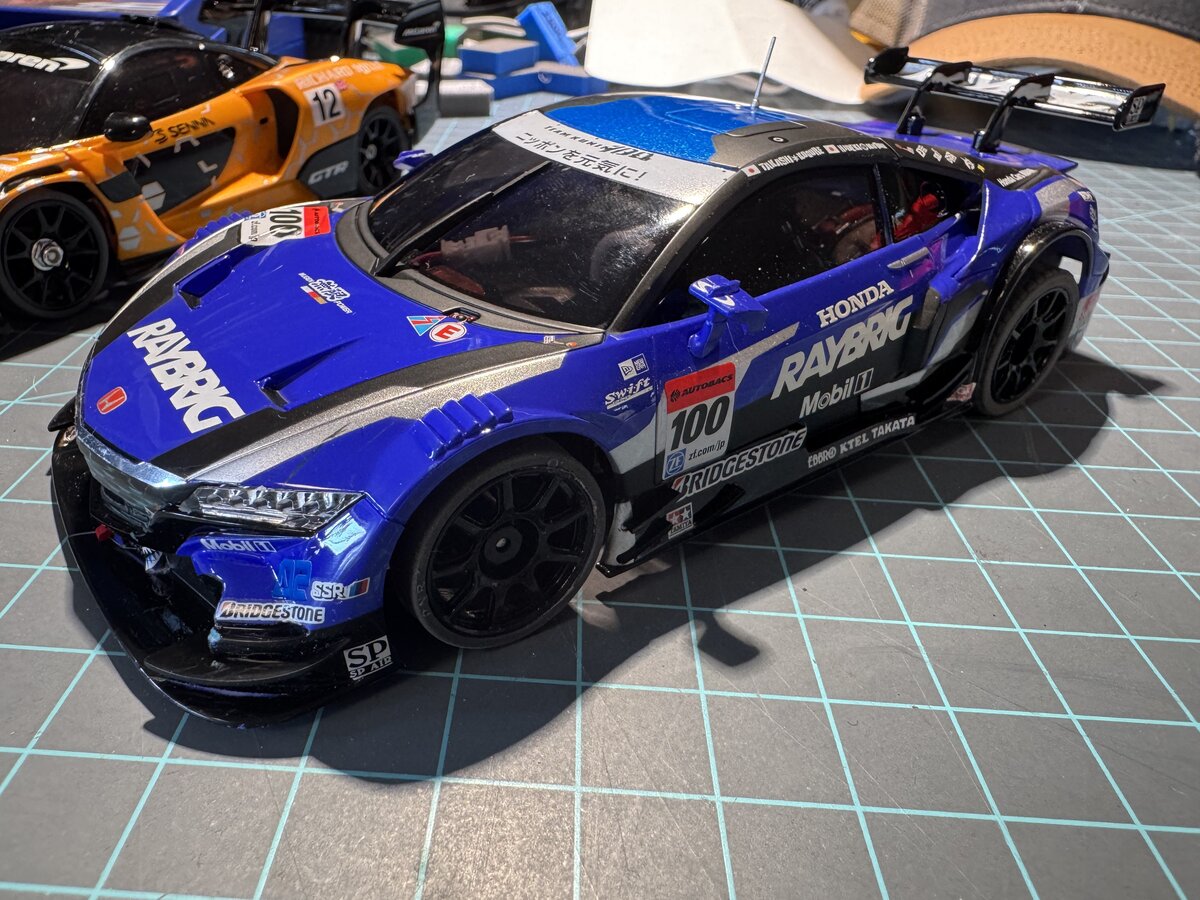
You just bolted on a fresh set of tires and the car feels worse than the worn set you pulled off. It vibrates down the straight, the rear grip changes from pack to pack, and no amount of compound swapping fixes it. Before you blame the tires or start throwing money at springs, look at whether those tires are actually round and matched. That is what truing does, and it is the single most overlooked step in Mini-Z tire prep.
This guide covers when to true, when to glue, the exact process, and the small tool kit that makes it repeatable. If you are still choosing compounds, start with the Mini-Z Tire Guide and the Best RCP Tires buyer’s guide. This is the step that comes after you have the right rubber in hand.
Why Truing Matters at This Scale
A Mini-Z tire is tiny, and the tolerances that ship from the factory are not tight. Two things go wrong out of the package:
- Out-of-round. The tire has a mold parting line and often a slightly high spot. On a 1/27 car spinning at real RPM, even a fraction of a millimeter of runout shows up as vibration and an inconsistent contact patch.
- Unmatched diameters. A set of four is rarely matched. If your left rear is 0.2mm larger than your right rear, the car pulls and the diff loads unevenly.
Truing fixes both. You are sanding the tire, while it spins on the wheel, until it runs perfectly concentric and you can match each pair. The payoff is not a magic grip jump. It is consistency: the car does the same thing every lap, which is exactly what you need to actually tune the rest of the setup.
Diameter Matching and Rollout: Why 0.1mm Matters
Matching diameter isn’t a cosmetic nicety. It’s the difference between a diff that loads evenly and one that’s fighting itself every corner. If your left rear is 0.2mm larger than your right rear, that tire is covering more ground per rotation than its partner, and the diff spends the whole lap compensating for a mismatch that never needed to exist. Match pairs within about 0.1mm and that problem disappears.
The same sanding pass also lets you set diameter on purpose. Take a little more off the rear and you’re lowering rollout, which behaves like a slightly shorter gear: quicker off the corner, a touch less top speed down the straight. It’s a small effect per truing pass, but if you’re taking real material off a well-worn set, you’ll feel it. If you want the full picture on how rollout interacts with your pinion choice, see the Pinion Gear Ratio Reference.
Truing: The Process
You are chasing round and matched, not a specific number on the calipers. Here is the sequence.
- Mount the tire fully on the wheel with the bead even all the way around.
- Spin it on a truer or mandrel. A dedicated Mini-Z tire truer holds the wheel on a motor-driven shaft. No truer? A rotary tool with a matching mandrel works, though it is harder to hold a consistent angle.
- Shape with coarse grit. Hold 240 to 400 grit wet/dry sandpaper lightly against the spinning tire, moving side to side. Let the grit do the work. Pressing hard flat-spots the tire and heats the rubber.
- Finish fine. Switch to 600 grit or higher for one light pass. This leaves a clean, consistent surface instead of a torn one.
- Measure and match. Digital calipers, both tires on an axle within about 0.1mm. Do the fronts as a pair and the rears as a pair.
Keep your passes light and symmetrical. The most common beginner mistake is grinding a cone shape into the tire by holding the paper at an angle. Move across the full width, keep the pressure even, and check often.
No Truer? The Rotary Tool Method
A dedicated tire truer is the easier path because the wheel spins on a fixed shaft that’s already true to itself. A rotary tool with a mandrel adapter does the same job with one real handicap: you’re holding a tool by hand instead of running the wheel on a fixed centerline, so any wobble in your grip becomes wobble in the tire.
A few things make this workable:
- Use variable speed and stay in the low-to-mid range. Full speed on a rotary tool generates enough friction heat to gum the rubber before you’ve shaped anything. Slower is more controllable and produces a cleaner surface.
- Brace your hands. Rest the tool arm against your body or a fixed support and keep the sandpaper hand braced against the same surface. Two floating hands is how you get a tapered, uneven tire.
- Check more often than you think you need to. With a dedicated truer you can eyeball roundness while it spins. With a rotary tool, stop and check with calipers every few passes instead of trusting the visual.
- Expect it to take longer. The tool isn’t the limiting factor, your steadiness is. Budget more time for your first few sets until the technique feels automatic.
It’s a real substitute, not a workaround you’ll regret. Plenty of racers true tires this way for years before buying a dedicated truer. It’s just a slower learning curve.
Gluing: When You Actually Need It
Here is where a lot of forum advice oversells the job. On Mini-Z, rubber radial tires usually do not need gluing. Kyosho and PN rubber tires are a friction fit on the wheel and hold fine for the vast majority of racing.
You glue in two situations:
- The tire creeps or walks. On a high-bite surface, a rear tire can occasionally roll or shift on the wheel under load. If you see the tire moving relative to the wheel, tack it.
- You are running foam tires. Foam always gets glued. It will not stay put otherwise.
The method is the same either way. Use thin CA glue (cyanoacrylate), not the thick gap-filling stuff. Seat the tire, then run a thin bead of CA into the seam where the tire meets the wheel bead and let capillary action wick it around. Rotate as you go so it pulls in evenly. A little goes a long way, and thin CA sets fast, so keep your fingers clear of the bead.
Do not flood the contact surface of the tire with glue. You want it bonded at the bead, not stiffened across the tread where it would kill grip.
Common Mistakes
- Pressing too hard while truing. Heat and flat spots. Light and patient wins.
- Skipping the finish pass. A coarse-only surface grips unevenly and glazes fast.
- Not matching diameters. Truing one tire and not its pair defeats the point.
- Over-gluing. Thick CA or too much of it stiffens the tire and reduces its ability to conform to the surface.
- Truing crawler tires. This guide is for MR-03, MR-04, and MA-020 rubber and foam. MX-01 crawler tires are a different animal and are not trued.
What to Buy
You can do this with a surprisingly small kit. Everything here is reusable across every set of tires you will ever run.
- Mini-Z tire truer. The tool that makes truing repeatable and fast. The PN Racing V3 Pro trues both tires at once so a pair comes off matched. It is a specialty item sold through hobby shops rather than Amazon: PN Racing V3 Pro Tire Truer. A rotary tool with a matching mandrel is the budget stand-in.
- Thin CA glue. For gluing foam and tacking any tire that walks. You want water-thin viscosity so it wicks into the bead seam, not the thick gap-filler. Bob Smith Insta-Cure Super Thin CA on Amazon.
- Wet/dry sandpaper. The consumable that actually does the truing. Keep a few grits on hand, from coarse (around 240 to 400) to fine (600 and up). 3M Wetordry sandpaper on Amazon.
- Digital calipers. Non-negotiable for matching pairs. You will use these for wheel offset and ride height too. Neiko 01407A digital calipers on Amazon.
If you do not own calipers yet, buy those first. They pay for themselves the moment you stop guessing whether your tires are matched. For the rest of the bench kit, see the Tools Guide, and once your tires are trued and matched, revisit the Wheel Offset and Width Guide to make sure the geometry underneath them is right.
Frequently Asked Questions
Do I need to glue Mini-Z rubber tires to the wheels?
Usually no. Kyosho and PN rubber radials are a friction fit and hold fine for most racing. Glue only becomes necessary if a tire visibly creeps or walks on the wheel under high grip, and even then a thin tack at the bead is enough. Foam tires are the exception and always need gluing.
Why should I true a brand-new Mini-Z tire?
New tires often ship slightly out-of-round with a mold parting line, and a fresh set of four is rarely matched in diameter. Truing makes each tire run concentric with the wheel and lets you match pairs to within about 0.1mm, which kills vibration and makes grip consistent lap to lap.
Does making the rear tire smaller change my gearing?
Yes. A smaller rear diameter reduces rollout, which behaves like a lower gear: the car accelerates a little quicker and loses a little top speed. It’s a small effect, but if you true a lot of rubber off you will feel it, so keep it in mind when matching a set.
What grit sandpaper should I use to true Mini-Z tires?
Start at 240 to 400 grit to remove material and shape the tire, then finish at 600 grit or higher to leave a clean surface. Skipping straight to fine grit takes forever, and skipping the finish pass leaves a rough surface that grips inconsistently.
How much smaller should I true my rear tires?
Enough to match your pair within about 0.1mm, and not much more than that unless you’re deliberately hunting a rollout change. Truing is a refinement pass, not a resizing tool. If you find yourself removing a lot of material to get a “matched” pair, the set probably shipped badly out-of-spec and you’re better off trying a different pair than sanding one tire down to meet the other.
Is a dedicated tire truer worth it over a rotary tool?
If you’re truing more than a couple sets a season, yes. A dedicated truer holds the wheel on a fixed shaft so you’re only managing the sandpaper, not the wobble of a hand-held tool. A rotary tool with a mandrel gets you the same result with more patience and more caliper checks along the way. Start with the rotary tool you probably already own, and upgrade once truing becomes a regular part of your routine instead of an occasional fix.
Bottom Line
Truing is not a competitive-only ritual. It is the step that makes every other tuning change readable, because a round, matched tire does the same thing every lap. Glue only what actually needs gluing, keep your passes light, match your pairs with calipers, and you will spend less time chasing a car that feels different every run. Browse compound and width options on the Shop Tires page.
Prices are approximate and change often. Check the listing for current pricing.
What I run up front. Slicks give a cleaner bite off the carpet than the stock radials once tire prep is dialed in. PN Racing lists every compound and width by SKU on its own page; Kenon Hobby is their worldwide distributor.
Shop →What I run out back. Radials give forgiving rotation without breaking loose under power. PN Racing lists every compound and width by SKU on its own page; Kenon Hobby is their worldwide distributor.
Shop →Medium compound, unidirectional tread. Good all-around for RCP and carpet.
Shop →Soft compound for high-grip RCP tracks. More rotation mid-corner, wears faster.
Shop →Precision molded, consistent compound across the batch. Track-ready.
Shop →Sized for the MR-04 narrow track width. Do not mix with standard Mini-Z tires.
Shop →