Best Mini-Z Transmitters in 2026: Ranked
Mini-Z transmitters ranked: stock KT-531P vs Futaba 4PM Plus vs KO Propo EX-NeXT, compared by features, price, and real track performance.
MR-03 · MR-04 · MA-020 · MX-01

The transmitter that ships with a Mini-Z ReadySet is designed to hit a retail price point. It works, but it gives you almost no tools for actually dialing in the car. No model memory, minimal rate adjustment, no expo.
Once you’ve spent time working on your setup, you understand how limiting that is. A better transmitter doesn’t make the car faster. It gives you the controls to use what the car is already capable of. The old standalone Kyosho Syncro EX-6R that used to be the default first upgrade is discontinued, so for most club racers the Futaba 4PM Plus on Amazon, paired with the matching Mini-Z receiver unit, is the right first upgrade now.
Worth noting: that’s the Kyosho EX-6R, the KO Propo EX-1, and the older Futaba 4PV all gone within a short stretch of each other, across three different price tiers. That’s not three unrelated products dying off one at a time. It’s a smaller field of dedicated Mini-Z-compatible radios than there used to be, which is part of why the picks below are current models, not the ones this guide used to point to.
None of that means everyone needs to buy a new radio. Plenty of club racers never make this upgrade and race just fine. The My Garage rundown of the ReadySets that actually get raced at club night still shows a stock KT-531P doing the job on both cars. A better transmitter doesn’t fix a driving problem, and if you’re still building consistency, tires, bearings, and a T-plate move the needle more (see Your First 5 Upgrades). Read the rest of this guide as “here’s what a radio upgrade actually buys you,” not “you’re behind if you haven’t bought one.”
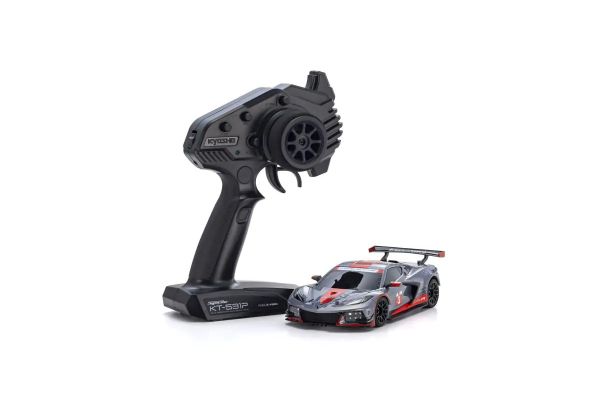
What You’re Missing With Stock
Expo (exponential steering curve): Makes the steering less sensitive around center while maintaining full travel at the extremes. At Mini-Z scale, where small inputs at speed matter enormously, expo makes the car dramatically easier to drive smoothly. This is the single biggest improvement a transmitter upgrade brings.
Dual rate: Reduces or increases overall steering travel. Useful across different track types: more rate for tight technical tracks, less for fast sweeping layouts. You can set this per model and switch on the fly.
Model memory: Saves all settings per car. You can switch between your MR-03 and MA-020 without resetting everything. Essential once you own more than one car.
Throttle curve: Shapes how the throttle responds to trigger input. Analogous to expo for steering. Useful for managing brushless power delivery and making corner exit more manageable.
Subtrim and servo travel: Fine-grained control over servo center and endpoint travel. Lets you get the steering perfectly centered without physical trim on the car.
Every one of those controls is worth exactly as much as your willingness to set it. A new radio out of the box is running defaults that are no better tuned to your car than the KT-531P was. If you want the numbers to start from rather than a menu to guess at, the Mini-Z Transmitter Settings Guide walks through dual rate, EPA, expo, and trim one at a time, with a baseline you can dial in on your first run.
Protocol and Receiver Units
The older MR-03 runs Kyosho’s ASF (Advanced Spread Frequency) 2.4GHz protocol. The current EVO and EVO2 chassis use the Mini-Z receiver unit system: you buy the chassis without a receiver, then plug in the receiver module that matches your radio (Futaba, KO Propo, Sanwa, or Kyosho Syncro). Your transmitter and receiver unit have to speak the same protocol, so this is the thing to verify before you buy.
When shopping transmitters, confirm there is a Mini-Z receiver unit for the radio you want. The Futaba 4PM Plus and the KO Propo EX-NeXT both have matching Mini-Z receiver units. Generic 2.4GHz transmitters from other surface RC brands typically have no compatible Mini-Z receiver, making them a worse path than buying a radio the platform actually supports.
The Futaba 4PM Plus: The Right First Upgrade
The Futaba 4PM Plus is the natural first transmitter upgrade for a current Mini-Z. It runs T-FHSS, and with the matching Mini-Z receiver unit it drops straight onto an EVO or EVO2 chassis. Features per-model memory, expo on both steering and throttle, dual rate, subtrim, and throttle curve. Futaba also sells the newer T4PM+ with SR (Super Response) mode if you want the faster response variant.
The ergonomics are strong and the wheel radio format suits Mini-Z well, especially if you also run other RC platforms and want one radio that covers everything. Setup from box to driving takes a few minutes once the receiver unit is bound.
This is the right choice for most drivers running club-level racing or casual track sessions. The price-to-feature ratio is strong, and you won’t outgrow it quickly.
The KO Propo EX-NeXT: Competition Grade
The old KO Propo EX-1 KIY is discontinued. Its replacement in the KO Propo line is the EX-NeXT, and the EX-NeXT Basic is what drivers at the Kyosho Cup level are moving to now. To run it on a Mini-Z you also need the KO Propo Mini-Z EVO receiver unit (part KOP10754), so budget for both. The signal resolution is noticeably higher than a stock KT-531P or an entry wheel radio.
Resolution in transmitter terms means how many discrete steps exist between center and full lock. More steps means finer control at small inputs. At Mini-Z scale and speed, the difference between 512 and 1024 steps is perceptible, especially when the car is at the limit in a corner.
What the EX-NeXT buys you over an entry radio:
- Real-time telemetry and ICS parameter adjustment from the transmitter
- Multiple model types with full setup storage
- Adjustable servo speed control
- Higher-quality mechanicals throughout
The EX-NeXT is more transmitter than most drivers will use, and with the receiver unit added it is a real investment. If you’re competing seriously at a regional or national level, it’s the right tool. For club racing, the Futaba 4PM Plus is where the money is better spent.
What to Avoid
Radios with no Mini-Z receiver unit: If there’s no matching Mini-Z receiver module for a transmitter, it won’t run on the chassis without swapping the receiver board. The cost and complexity of that makes it a worse path than buying a radio the platform actually supports.
Older FM/AM transmitters: No. The current 2.4GHz digital systems exist for good reason. Don’t go backwards.
Binding a New Transmitter
Binding is straightforward:
- Power off both transmitter and receiver.
- Hold the binding button on the receiver board (location varies, check your car’s manual).
- Power on the receiver while holding the bind button.
- Power on the transmitter.
- The receiver LED will indicate successful binding, typically a solid light after flashing.
Once bound, check and correct servo center with subtrim before driving. Confirm steering direction is correct. These take 60 seconds and avoid surprises on track.
New to Mini-Z and deciding what to spend money on first? See Your First 5 Upgrades. The transmitter falls after bearings, tires, and T-plate in the priority order.
Ready to shop? Browse curated transmitter and receiver picks on the Mini-Z Radio page.
Related Guides
- Mini-Z Transmitter Settings Guide: Bought the radio, now set it up. Dual rate, EPA, expo, and trim explained with a working baseline for each.
- Gyro Setup: A gyro’s effectiveness is directly tied to your transmitter’s expo and gain settings
- ESC Tuning Guide: Throttle curve on your transmitter works alongside ESC punch and brake settings
- Brushless Conversion: Throttle curve programming becomes essential once you go brushless
- How to Read a Setup Sheet: Expo, dual rate, and steering sensitivity settings belong on every setup sheet. This guide covers every field worth tracking at club night.
- Mini-Z Wear Points: What to inspect and when to replace, including the motor and electronics checks.
Product images courtesy of Kyosho.
Prices are approximate and change often. Check the listing for current pricing.
The standard Mini-Z transmitter upgrade now that the Syncro EX-6R is discontinued. T-FHSS, pairs with the matching Mini-Z receiver unit. Per-model memory, dual-rate, expo, and throttle curve.
Shop →Replacement for the discontinued EX-1 KIY. What drivers at the Kyosho Cup level are moving to now. Requires the separate KO Propo Mini-Z EVO receiver unit. Finer resolution than the 4PM Plus. The choice for serious competitors.
Shop →OEM replacement receiver/ESC board for the MR-03 EVO. Compatible with KT-531P and Syncro Touch radios.
Shop →OEM receiver/ESC board for the MA-020 AWD platform. Not interchangeable with MR-03 boards.
Shop →OEM receiver/ESC board for the MR-04. Paired to the MR-04 chassis dimensions and motor position.
Shop →