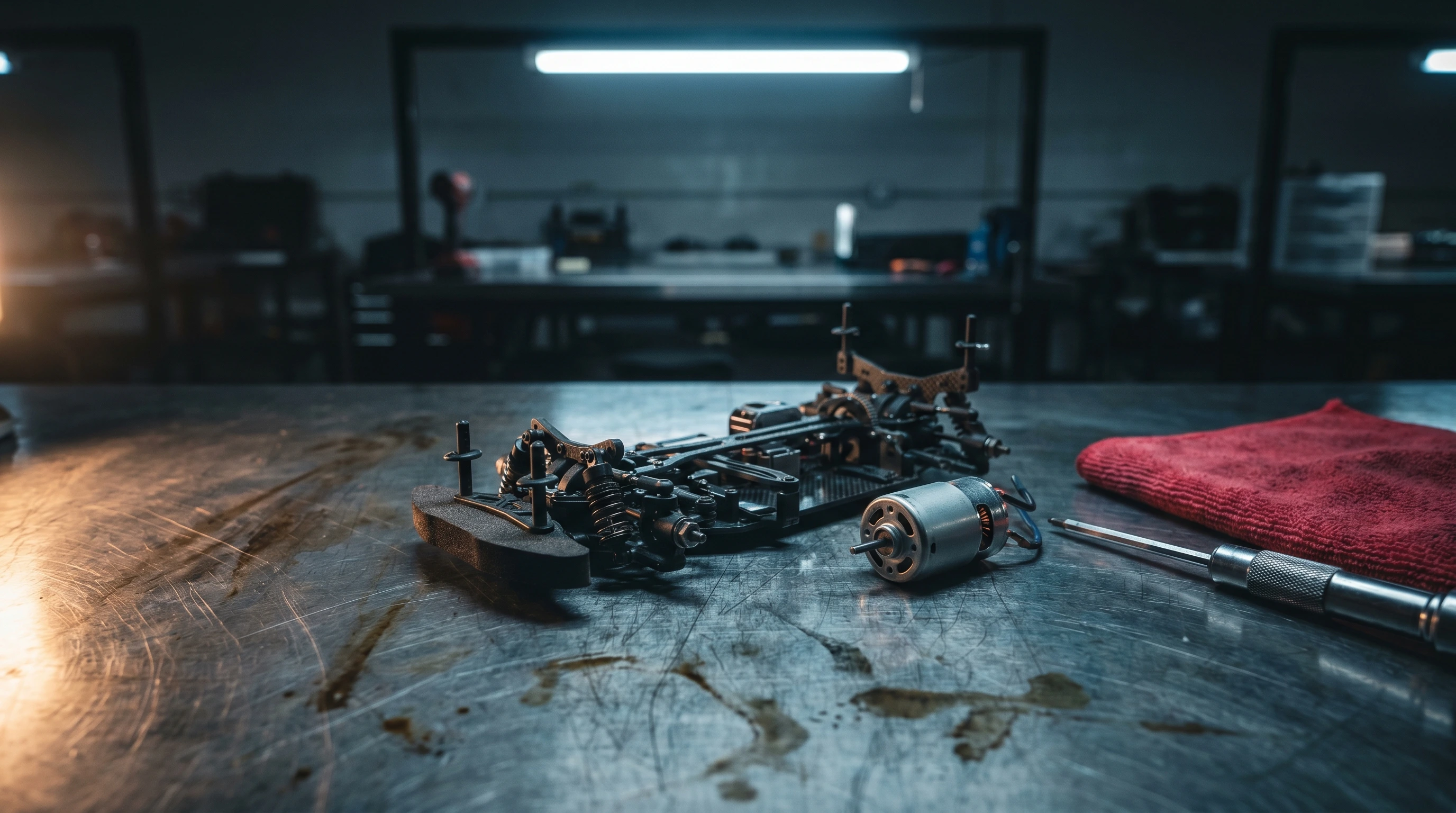
I’m going to say something that will probably get me ratio’d on the Mini-Z subreddit.
Brushed is better for club-night MR-03 racing.
Not “brushed is fine for beginners.” Not “brushed is a good starting point.” I mean it’s actually the better choice for the majority of racers showing up to a Tuesday-night club session on an RCP track, and the fact that the hobby has sleepwalked into treating brushless as an obvious upgrade has cost a lot of racers more than it’s gained them.
Let me explain why, and you can tell me where I’m wrong.
The Argument for Brushless Is Weaker Than It Sounds
The standard pitch goes like this: brushless motors are more efficient, more powerful, and have a flatter power curve than brushed. All of that is technically true. What’s missing from the pitch is the context that makes it matter, or at club-night scale, mostly doesn’t.
Efficiency: Yes, brushless runs cooler and wastes less energy as heat. On an MR-03 racing five-minute heats on carpet, this is not a limiting factor. I have never once thought “my brushed motor would have made the heat if it just ran cooler.” Heat is a non-issue at this scale, on this track type, in this format.
Power: More top-end power on a 1/28-scale car on a 12x8-foot RCP layout. Great. Except the top-end straight on most club tracks is three feet long and you’re already on the brakes before you get there. The speed I actually need is low-speed torque and corner-exit pull, and a properly tuned brushed motor delivers that with better feel than brushless in the hands of most club racers.
Flat power curve: This is the real selling point, and it’s also where the argument falls apart. Brushless does deliver power more linearly. But “linear” and “smooth” are not the same thing at low speed. Brushless in the 1/28 scale context tends to have an on/off character at low throttle percentages that makes corner exits harder to manage, not easier. You hit the throttle out of a slow hairpin and the car picks up too fast, the rear pushes out, and you’re correcting instead of driving. The brushed motor’s natural power curve (slightly lumpy at low RPM, building progressively) actually gives you more feel for what the rear is doing.
What Club-Night Racing Actually Rewards
I want to be specific about what we’re talking about, because Mini-Z racing at the club level is a specific thing. RCP track. Carpet surface. Tight layout, usually with several hairpins. Five to eight cars in a heat. Four to six-minute race format. Lap times in the six-to-ten-second range on most layouts.
In that format, what matters is: consistency, low-speed precision, and how well you can manage the entry and exit of slow corners. That’s it. Top speed is irrelevant on most layouts because you never fully reach it. Outright power advantage is marginal because your lap is 70% corners.
What brushed gives you in this specific context is traction feel. The motor’s natural power characteristics mean the rear gives you information before it gives up. You can feel the grip level through the throttle. You’re not guessing whether you’re on the edge. You’re sensing it.
Brushless takes that feedback away. The power comes in harder, which is fine if your throttle timing is already clean. Most club racers, even experienced ones, are not that consistent lap to lap. They need the forgiving power curve more than they need the efficiency or the peak numbers.
The One Argument for Brushless I Actually Respect
Here is where I’ll give the other side credit: if your club runs a brushless class and you want to compete in it, run brushless. That’s not a counterargument. It’s a class rule.
And if you’re racing at a level where your laps are consistent to within a tenth, you’ve optimized your T-plate, your tire compound is dialed for the surface, and you’re actually late-apexing every hairpin correctly, yes, a brushless motor might find you time in the places where brushed genuinely has less torque output. But at that point you probably already know this. You don’t need me to tell you.
What I object to is the default assumption that brushless is the right move for the average club racer. It’s not. It’s a tool for a specific level of driving that most people haven’t reached yet. If you decide you want to go that route anyway, the brushless conversion guide covers motor KV selection, ESC compatibility, and what actually changes on track.
The Cost Argument Nobody Wants to Make
Brushless systems for the MR-03 (motor, ESC, and a compatible receiver if you’re changing the whole stack) can easily run $80 to $150. A brushed motor upgrade costs $15 to $25 and drops in without touching anything else.
If the brushless system made you measurably faster, this would be an easy call. But for most club-night racers it won’t. It might even make you slower in the short run while you adapt to the different power delivery. You’ll spend $120 and wonder why your lap times didn’t improve, and the answer is that they didn’t improve because the motor wasn’t the bottleneck.
Spend the $20 on a better brushed motor. Spend the rest on more track time, or on tires, or on a T-plate session where you actually figure out what your car wants. That investment will show up in your lap times. The brushless upgrade probably won’t.
What I Actually Run
Stock class: Kyosho X-Speed brushed motor, stock ESC. I run it because the class requires it, but also because racing stock class is where I learned the most about driving. No excuses from the equipment.
If you want to try brushless, try it. This isn’t a religion. But go in with realistic expectations, and don’t assume you’ll be faster just because the motor spec sheet says you should be.
The fastest car at most club nights is the one the driver can feel. Right now, for me, that’s still brushed. If you haven’t already, run stock class first: it’s where the real learning happens before any of this matters.
Mini-Z Modder